

Every Y-plate vehicle in Malta has to carry a working tracking device, and has done since September 2020. If yours stops reporting on a Tuesday, the vehicle is supposed to come off the road that day, not at the end of the month when somebody finally runs a report.
Most operators know a device is required. Fewer know what the rule asks of them once it is fitted, and fewer still could produce the trip log that sits alongside it if Transport Malta asked this afternoon.
This page covers the device and the records around it. For licence categories, garaging, driver permits and the rest of the July 2026 reform, start with the 2026 Y-plate operator guide.
What the law requires
The rule is regulation 36 of the Light Passenger Transport Services and Vehicle Hire Services Regulations. It has six parts, and it puts the duty on the operator rather than the driver.
| Your obligation | What it means in practice |
|---|---|
| Fit a device to every vehicle on the licence | One per vehicle, not one per fleet. A car added mid-year needs one before it carries passengers |
| Keep it in working condition at all times | Somebody has to be watching. The rule assumes you know today, not next month |
| Report faults to Transport Malta immediately | A written route to the Authority, not a note to your installer |
| Take a defective vehicle off the road | Immediately, and it stays off until the device is repaired or replaced |
| Keep it switched on while carrying passengers | The driver's job, and the one part of the rule that sits with them |
| Hand over the data when asked | In any reasonable format the Authority requests |
Nobody may interfere with the device, and that covers you, your drivers and anybody you hire to work on the vehicle. Once Transport Malta or an approved body has inspected a device, it carries a seal that has to stay intact.
What happens when a device stops working
This is the part that costs money, and the sequence is worth being clear about.
The moment a device is defective or has been tampered with, three things are true at once. The fault has to reach Transport Malta immediately. The vehicle has to stop carrying passengers. It stays off the road until the device works again.
The penalty for getting this wrong is 100 euro. A car standing in the yard for three days costs considerably more than that, which is the real reason to care.
But the three days only start when somebody notices. If the first sign of a dead tracker is a gap in a monthly report, the vehicle has already been out of compliance for weeks, and it was carrying fare-paying passengers the whole time.
How to fix a dead tracker without parking the car
Regulation 36 is unconditional about taking the vehicle off the road. It says nothing about what the replacement device has to be, or who has to fit it.
That distinction is worth money, because the two kinds of device are not fitted the same way.
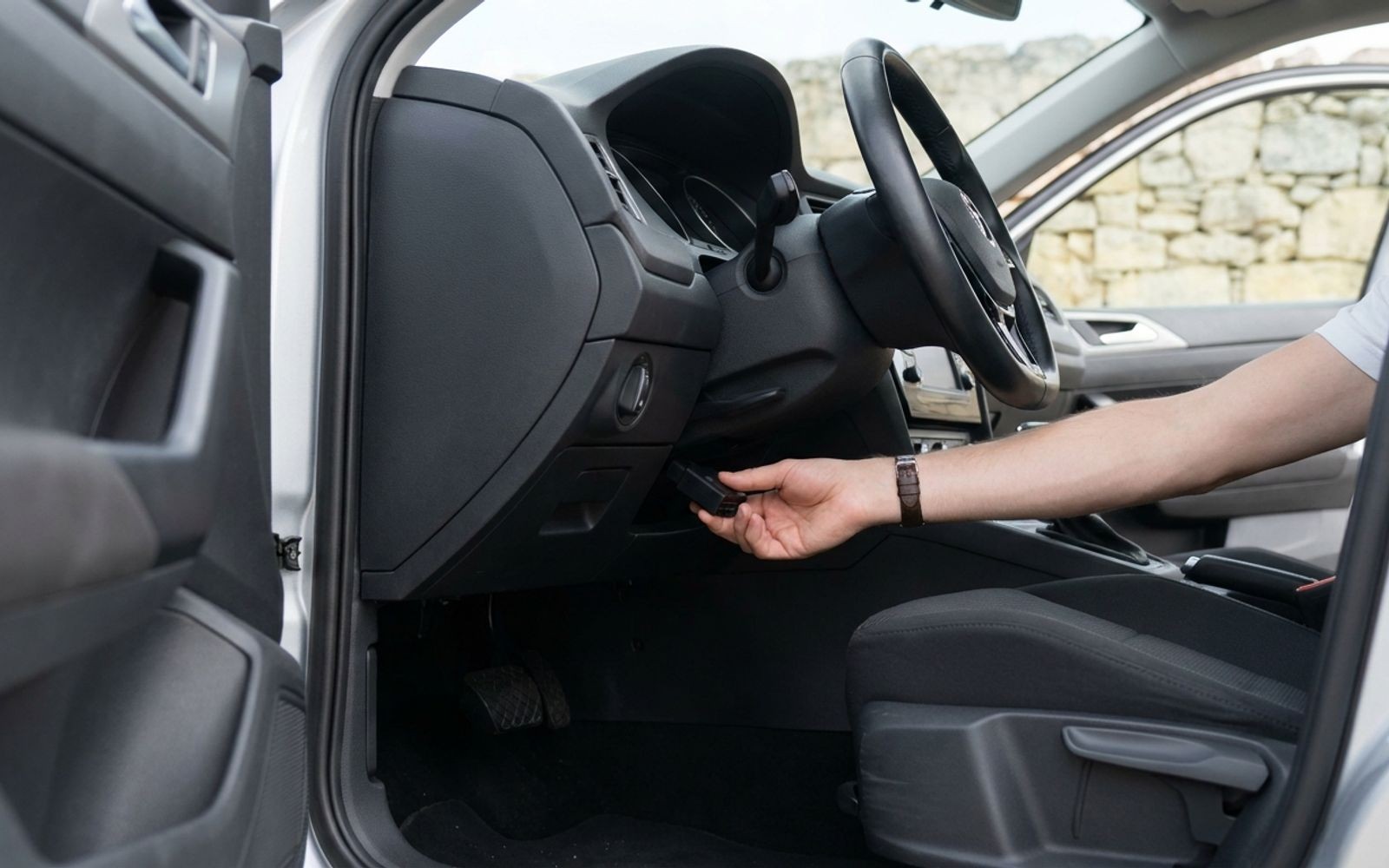
A wired unit goes behind the dash and onto permanent power. It needs an appointment and about an hour per vehicle. A plug-in unit goes into the diagnostic port instead, and takes under a minute with no tools. Plug it in, drive away, that is the install.
That gap is what a spare is for. Instead of a car standing until an auto electrician has a free slot, somebody collects a plug-in unit, puts it in the port, and the vehicle keeps reporting while the wired one is repaired on your schedule rather than on the clock. We keep OBD units ready for collection for exactly this.
Plug-in units work in any vehicle with an OBD-II port, which covers most petrol cars from 2001 and most diesels from 2004. One spare covers a whole fleet, because it moves between vehicles as easily as it goes into the first one.
What Transport Malta has not specified
Regulation 36 twice points at specifications the Authority sets: what the device records and transmits, and what it is inspected and sealed against. Neither has been published.
There is no list of required data fields, no transmission frequency, no retention period, and no register of approved devices or suppliers.
The trip log most operators are missing
Regulation 18 sits next to the tracking rule and catches far more operators out, because most of it has nothing to do with the tracker.
You have to keep a log for every hire, for one year. Three things go in it.
| What the regulation asks for | Where it comes from |
|---|---|
| Date and time of departure and arrival | The tracking system, on its own |
| The driver's name and permit number | Only if drivers identify themselves at the wheel |
| The name and details of the hirer | Your booking records. No tracker knows this |
Two of the three never come from telemetry. And the penalty here is 200 euro, double what the tracking device itself carries.
The fix is unglamorous. Give drivers a way to identify themselves when they start a shift, so a trip attaches to a named person. Then keep booking records that can be joined to those trips by date and vehicle. If those two sit in systems that never speak, a request for a year of records turns into a week of manual work.

What a tracking system covers, and what it does not
Ours included. Here is how the obligations map onto what tracking can actually do for you.
| Obligation | What a tracking system does | What it does not cover |
|---|---|---|
| Device fitted and working | Hardware fitted locally, with offline and power alerts by email and push, so a dead unit surfaces the same day | Reporting the fault to Transport Malta is still a person's job |
| No interference | A wired unit sits behind the dash on permanent power and raises a power alert if it is pulled | A plug-in unit comes out in a second, so operators who want a tamper-proof install ask us for a wired one |
| Vehicle off the road | The same alerts catch it on the day, and a spare plug-in unit keeps the vehicle reporting in under a minute while the wired one is repaired | A spare does not repair the primary, and it does not report the fault to the Authority for you |
| Recording and transmitting | Position updates while the vehicle moves, with event-based reporting alongside, at a frequency and a history depth that depend on the plan | No supplier can tell you whether this matches an unpublished specification |
| Handing data over | Trip, trail, movement and driver reports, exported to PDF or Excel | |
| The trip log | Driver tags, iButton or Bluetooth, attach each trip to a named driver | The hirer's details live in your booking system, not in any tracker |
Two things worth stating because they are often assumed. Tracking does not monitor the 12-hour driving limit, which Transport Malta measures from platform login and logout. It does not enforce rank geofencing, which runs on the booking app.
What we run for Y-plate operators covers the device, the fitting and the reporting, and what it costs is published rather than quoted on request. The wider setup for fare-paying passenger work is on the passenger transport page.
How to check where you stand
Five checks, and four of them need nothing from a supplier.
- Ask how you would find out that a device had stopped reporting. If the honest answer is that somebody notices eventually, that is your exposure.
- Pull last month's trip log and try to fill all three columns. The gap usually appears within ten minutes.
- Confirm every vehicle currently on your licence has a working device, including anything added since the last renewal.
- Write down who reports a fault to Transport Malta and how, before you need it.
- Ask what you would actually do on the day a device fails. If there is no spare in a drawer, the answer is a car standing until somebody has a free slot.
Common questions
Is the tracking requirement new?
No. It has applied since 4 September 2020. It arrived with the original Light Passenger Transport Services Regulations, not with the recent reform.
Did the July 2026 changes affect it?
Not directly. L.N. 171 of 2026 left regulation 36 untouched. It added a duty on booking platforms to build an API into the Authority's monitoring and enforcement system and to collect tracking device details for fleet operators, which points at where enforcement is heading.
Is there an approved device list?
No. No register of approved devices or suppliers has been published.
Do GY and LY plates both count?
Yes. Both are light passenger transport marks and carry the same obligations. LY is the series in current use and GY appears on older vehicles.
Should I use a plug-in or a wired unit?
We prefer plug and play, because it goes in immediately and keeps the vehicle earning. A wired unit is the answer when you want it tamper-proof, since the rule prohibits interference and contemplates a seal. Either way, keep a plug-in spare available so a failure does not park the car.
Can I fit a tracker myself?
A plug-in unit, yes. It goes into the diagnostic port in under a minute with no tools. A wired unit needs an appointment and about an hour, with a one-time fitting charge listed on the pricing page.
Does my GPS data satisfy the trip log?
Only the first line of it. The driver's permit number and the hirer's details have to come from somewhere else.
What does a breach cost?
100 euro for the tracking device obligations and 200 euro for the log. The larger cost is a vehicle standing idle while a device is repaired.
What we would do next
If a booking platform has asked you for device details, or you have just realised you could not fill all three columns of the trip log, start with the sheet rather than the shopping. Write down what is fitted in each car, registration by registration, and check which of them reported today. The gap usually shows up in the first three rows.
Tell us what is fitted in your cars and we will tell you what is missing, whether or not you buy anything from us.
If you want the tracking itself sorted, the plans and what each one includes are on the pricing page, published rather than quoted on request. We hold plug-in units for collection so a failure does not park a car while it waits for an electrician.
Sources
Read on 29 August 2026.
- Light Passenger Transport Services and Vehicle Hire Services Regulations, L.N. 366 of 2020, consolidated at S.L. 499.68
- L.N. 171 of 2026, in force 29 July 2026
- Transport Malta number plates and licensing pages
Related: the 2026 Y-plate operator guide covers licensing, garaging and driver permits.
Chris Bartolo, Founder. Current at 29 August 2026. This is a summary of published rules and not legal advice. Verify anything load-bearing with Transport Malta before acting on it.